
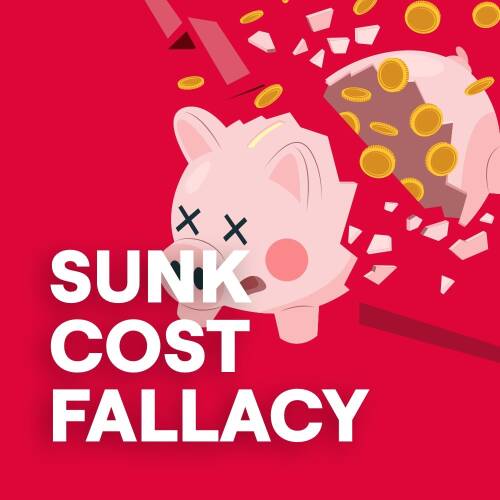
In software development and project management, there is a phenomenon that repeatedly lures even experienced decision-makers into a trap: the Sunk Cost Fallacy. This psychological pattern causes us to hold on to projects that have long since lost their future – simply because we have already invested a lot. This article examines how this cognitive bias works, what impact it has on technical projects, and how to escape this mental trap.
What does "Sunk Cost Fallacy" actually mean?
The Sunk Cost Fallacy describes an irrational decision-making pattern: We hold on to projects, products, or strategies simply because we have already invested time, money, or other resources – even when all signs indicate that abandonment would be the better option.
Sunk costs are by definition resources that have already been spent and cannot be recovered. Rationally speaking, these past investments should play no role in future decisions. However, reality looks different:
"We've already invested so much time in development, we can't just stop now."
"The framework may be outdated, but we've invested so much in it – switching would be wasteful."
This way of thinking is deeply rooted in our psychology and is based on several cognitive biases, particularly loss aversion: The pain of losing something weighs psychologically heavier than the joy of gaining something of equal value.
Concrete examples from daily project work
The Sunk Cost Fallacy meets us in the IT world daily – here are some typical scenarios:
The legacy system no one wants to touch
A company operates a web application based on outdated technology. Maintenance is becoming increasingly complex, new features can hardly be implemented anymore. Nevertheless, they decide against modernization with the justification: "We've invested so much in the system over the years, a rewrite would be wasteful." The consequence: Rising maintenance costs, frustrated developers, and an increasingly dissatisfied customer base.
The unused software license
A team acquired an expensive enterprise software license two years ago. After initial enthusiasm, hardly anyone uses the tool anymore, as it proved unsuitable for the workflows. Nevertheless, the contract is renewed year after year: "We've invested so much in implementation and training, we can't just switch now." The costs continue to run while better alternatives remain unused.
The project without end
A development project has been running for months over budget and schedule. The original requirements have changed, the team is struggling with technical debt, and market demand has shifted. Nevertheless, the project continues: "We've already invested so much, we have to see it through." In the end, there is a product that no one needs anymore – at high cost.
These examples show how the Sunk Cost Fallacy can lead to a spiral of bad decisions. The psychological mechanism behind it is complex: We don't want to admit that our previous investments may have been in vain. Additionally, confirmation bias plays a role – we selectively search for information that justifies our previous decisions.
Why the Sunk Cost trap is so dangerous
The effects of the Sunk Cost Fallacy go far beyond the obvious waste of resources:
Delayed innovation
When companies hold on to outdated technologies, they miss opportunities for innovation and competitive advantages. In the fast-paced IT industry, this can be existentially threatening.
Declining team motivation
Developers and project teams often intuitively sense when a project has reached a dead end. Holding on to such projects leads to frustration, declining motivation, and ultimately to the loss of valuable employees.
Missed opportunities
Every resource that flows into a suboptimal project is missing elsewhere. The true costs of the Sunk Cost Fallacy therefore also include all the missed chances and unrealized projects.
Technical debt
In software development, holding on to existing systems often leads to an accumulation of technical debt. What appears as cost savings in the short term develops into an expensive problem in the long term.
Perhaps the most dangerous characteristic of the Sunk Cost Fallacy is its self-reinforcement: The longer a project runs and the more has been invested, the harder it becomes to pull the plug – even when the signs of failure become increasingly clear.
How to recognize if you're stuck in the trap
The realization that one may be subject to a cognitive bias is the first step to overcoming it. The following questions can help identify the Sunk Cost Fallacy:
Would you still start the project the same way today?
Imagine you were at the beginning of the decision today – with the knowledge you have now. Would you start the project in this form? If the answer is "no", the Sunk Cost Fallacy could be at play.
Are you only holding on because you've already invested a lot?
Honestly analyze your motives: Do previous investments play a central role in your decision to continue the project? Or are there convincing future-oriented reasons?
What would an uninvolved third party decide?
Imagine a new CTO or project manager would take responsibility tomorrow – without emotional attachment to previous decisions. What recommendation would this person give?
What opportunity costs arise?
What could you achieve with the resources currently flowing into the questionable project? Are there alternatives that promise higher value?
Have you defined clear success criteria?
Projects without clear success criteria are particularly at risk of falling into the Sunk Cost trap. If you haven't defined when a project is considered successful – or when it should be aborted – an objective evaluation becomes difficult.
Honestly answering these questions can be uncomfortable, but it helps to break through irrational decision-making patterns and refocus on the future.
How to get out – Strategies against the Sunk Cost Fallacy
The good news: There are proven strategies to escape the Sunk Cost trap:
1. Objectification through external perspectives
External consulting or a peer review can help gain the emotional distance necessary for rational decisions. External experts are not biased by previous investments and can provide an objective assessment.
2. Introduce prospective evaluation
Establish a decision-making process that is consistently future-oriented:
- Evaluate only remaining costs vs. expected benefits
- Consciously ignore previous investments in decision-making
- Ask: "If we were starting from zero today – how would we proceed?"
3. Define clear stop criteria
At the beginning of a project, establish measurable criteria that trigger an abort or fundamental realignment:
- Budget caps
- Time milestones
- Quality metrics
- Usage numbers or conversion rates
These criteria should be documented in writing and reviewed regularly.
4. Establish a culture of constructive failure
In many organizations, ending a project is seen as failure. This view reinforces the Sunk Cost Fallacy. A healthier perspective: Recognizing and ending a suboptimal project in time is a success – it saves resources and enables better alternatives.
5. Smaller iterations and MVP approach
The danger of the Sunk Cost Fallacy grows with project size and duration. An agile development approach with short iterations and early prototypes reduces the risk of investing too much in the wrong direction.
Implementing these strategies requires both structural changes in decision-making processes and a rethinking at the personal level. The key lies in consistently aligning decisions with future results, not past investments.
Sunk Cost Fallacy in software development – typical scenarios
In software development, the Sunk Cost Fallacy manifests in particularly characteristic patterns:
Continuing legacy code development at any cost
A classic scenario: An application is based on outdated technology, is difficult to maintain, and only meets modern requirements with great effort. Nevertheless, it continues to be developed instead of considering a rewrite or fundamental refactoring.
The rational alternative: An objective evaluation of the long-term costs of both options, taking into account factors such as maintainability, development speed, and future viability.
Custom developments instead of proven solutions
"Not invented here" meets Sunk Cost Fallacy: A team has invested a lot of time in a custom development, even though mature open-source alternatives or commercial products now exist that would be better and cheaper.
The rational alternative: Regular make-or-buy analyses that exclude existing investments and focus on future maintenance effort.
Ignoring technical debt
"We don't have time to improve the code – we need to deliver features." This short-term thinking leads to a vicious circle: The more technical debt accumulates, the more effort it takes to fix it, which in turn is used as an argument against refactoring.
The rational alternative: Budget a fixed amount for technical debt and set continuous code quality as a priority.
Maintaining outdated architectural decisions
Early architectural decisions are often maintained even when requirements have fundamentally changed. The reason: "We've built so much on it, a change would be too costly."
The rational alternative: Regular architecture reviews with the willingness to make fundamental changes when necessary.
In all these scenarios, a common pattern emerges: Short-term avoidance of change leads to higher long-term costs. Overcoming the Sunk Cost Fallacy requires the courage to view past investments as irrelevant for future decisions.
Conclusion – Make better decisions without baggage
The Sunk Cost Fallacy is a powerful psychological mechanism that can mislead even experienced decision-makers. Awareness of this cognitive bias is the first step to escaping it.
The key insights:
- Sunk costs are irrelevant for rational future decisions
- Emotional attachment to past investments leads to suboptimal decisions
- Clear criteria, external perspectives, and future-oriented evaluations help escape the trap
- In software development, the Sunk Cost Fallacy manifests particularly in attitudes toward legacy code and technical debt
Good leadership is not shown in seeing a project through at any cost, but in the ability to say "stop" in time when continuation no longer promises appropriate value. The courage to accept sunk costs as such and look forward is a crucial quality of successful decision-makers.
The future of your project is not determined by the resources already invested, but by the decisions you make today. Free yourself from the baggage of the past and focus on what really matters: the future value of your decisions.
Do you need support in objectively evaluating your project or a second opinion on an upcoming decision? Our experts for strategic consulting are happy to help you set the right course for the future.