
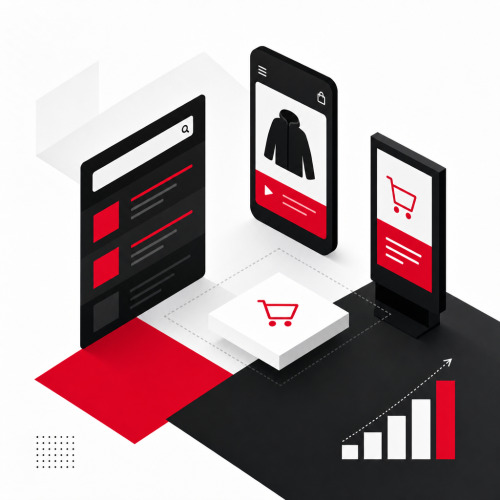

You're looking for a winter jacket on Amazon – and the first three results are sponsored. You scroll through the Zalando app – a video banner from a fashion brand appears. You walk past the checkout at a supermarket – a personalized ad runs on the digital screen next to it. This is Retail Media: advertising that leverages the moment of purchase, data-driven and measurable like no other channel before.
Retail Media refers to advertising space that retailers sell on their own digital and physical channels to brands – based on high-quality first-party purchase data of their customers. The global market grew to a volume of $179.5 billion USD by 2025 and is expanding twice as fast as social media. For marketers, this topic is simply no longer ignorable in 2026.
How Retail Media is strategically integrated into a modern media mix is a central component of our Performance Marketing expertise.
What is Retail Media – and what is it not?
Retail Media is more than just sponsored search results on Amazon. The term encompasses all advertising formats that a retailer markets on its own channels – from the website to the mobile app to the digital screen in the store. The data foundation is crucial: Unlike traditional advertising, Retail Media is based on the actual purchase data of the respective retailer's customers.
Not every digital advertisement that appears in a retailer's environment is automatically Retail Media. The Retail Media definition according to eMarketer is: An asset is considered Retail Media if it is owned by a retailer or a third-party provider works with that retailer's first-party buyer data. Traditional display advertising that a retailer buys on third-party spaces does not fall under this.
The distinction from Affiliate Marketing is also important: Affiliate is performance-based and works with third-party reach, Retail Media is owned inventory with owned customer data.
| Feature | Retail Media | Traditional Display Advertising | Affiliate Marketing |
|---|---|---|---|
| Data Foundation | Retailer's first-party purchase data | Third-party data / Cookies | Third-party reach |
| Inventory | Own retailer channels | Third-party spaces | Publisher networks |
| Billing Model | CPM, CPC, fixed price | CPM, CPC | CPA (Cost per Action) |
| Targeting Quality | Very high (purchase intent) | Medium | Variable |
| Measurability | Closed-loop possible | Limited | Good (last click) |
| Proximity to Purchase | Very high | Low–medium | Medium |
What distinguishes Retail Media from Google Shopping?
Google Shopping intercepts search queries that occur outside the retailer ecosystem – on the Google search results page. Retail Media, on the other hand, operates directly in the retailer's environment when purchase intent is already concrete. Someone who opens the app of a German grocery retailer typically has a significantly higher purchase intent than someone who generically searches for a product on Google.
Another essential difference is the data foundation. While Google Shopping is based on search data, Retail Media uses actual purchase histories, shopping cart data, and loyalty programs – a data depth that Google simply does not possess.
How has Retail Media evolved – from supermarket shelf to digital advertising network?
Retail Advertising is actually ancient. Manufacturers have always paid for better shelf placement, displays, and themed setups in stores. The principle "brand pays retailer for more visibility at the point of sale" is not an invention of the digital age.
The decisive turning point came in 2012: Amazon launched its programmatic advertising platform Amazon Ads Platform (AAP) and thus created the first scalable, data-driven version of what we know today as Retail Media. The success was meteoric – from around $600 million USD in the first year to around $60 billion USD in advertising revenue in 2024.
This success did not go unnoticed. Walmart, Target, Kroger, and Instacart in the USA – and in Germany Otto, Zalando, REWE digital, dm, and Thalia – began building their own networks. In total, over 200 new Retail Media Networks have been created worldwide in recent years. Retail Media is thus no longer a niche topic, but an independent billion-dollar market.
| Year | Event | Significance |
|---|---|---|
| 2012 | Amazon AAP goes live | Birth of modern Retail Media |
| 2015–2018 | Walmart, Target launch own networks | Retail Media becomes industry trend |
| 2020–2021 | Pandemic boom in e-commerce | RMN growth accelerates massively |
| 2022 | Google announces end of third-party cookies | First-party data becomes strategically crucial |
| 2023–2024 | CTV partnerships (Instacart × Roku, Amazon × Prime Video) | Retail Media expands into TV sector |
| 2025 | Global market exceeds $179.5 billion USD | Retail Media overtakes linear TV |
| 2026 | AI-powered hyper-personalization becomes standard | Real-time targeting at individual level |
Why is Retail Media booming specifically in 2025 and 2026?
Four structural drivers ensure that Retail Media growth is no coincidence:
-
The end of third-party cookies: With the gradual elimination of traditional cookie-based advertising, retailers' first-party data becomes the strategically most important targeting resource in digital advertising. More on consent and data strategy: Google Consent Mode
-
The ROPO effect: "Research Online, Purchase Offline" describes the behavior of consumers who research online and buy offline – and vice versa. Retail Media is the first channel to make this cycle completely measurable.
-
Margin pressure in core retail: Traditional retail achieves margins of 2–4%. Retail Media onsite advertising achieves margins of 70–90%. For retailers, this is an existential new revenue source.
-
AI makes targeting truly precise: Machine learning enables the evaluation of purchase signal data in real-time and the delivery of advertising at an individual level – in a quality that would not be achievable manually.
How does Retail Media work in practice – from booking to delivery?
The process of a Retail Media campaign is more clearly structured from a brand's perspective than many think. At its core, it's about using the retailer's inventory and data to address precisely those consumers who are already in a purchase situation.
A typical campaign follows these six steps:
-
Define goal and KPIs: ROAS, iROAS, or brand awareness – depending on the funnel position, success metrics differ fundamentally.
-
Select network: Which retailer reaches the relevant target audience? Amazon for broad consumer goods, Zalando for fashion, REWE digital for FMCG.
-
Choose channel and format: Onsite (Sponsored Products, Display), Offsite (Social Ads based on 1P data), or In-Store (Digital Signage)?
-
Activate target audience: Segmentation based on purchase history, shopping cart data, loyalty status, or behavioral patterns.
-
Book and deliver campaign: Via self-service platforms or managed service – delivery often occurs via real-time bidding.
-
Measure and optimize: Closed-loop reporting directly links ad delivery with retailer purchase data.
What are onsite ads – and what formats exist?
Onsite Retail Media takes place directly on the retailer's platforms – on the website, in the app, on the search results page, or on product detail pages. Currently, over 80% of total Retail Media spending is on this channel.
| Format | Placement | Funnel Position | Strength |
|---|---|---|---|
| Sponsored Products | Search results, category pages | Bottom of Funnel | High purchase intent, direct conversion relevance |
| Sponsored Brands | Top of search results pages | Mid–Bottom of Funnel | Brand awareness + Click |
| Display Banner | Homepage, category, CRM emails | Top–Mid of Funnel | Reach, awareness |
| Native Ads | Integrated in content flow | Mid of Funnel | Less intrusive, high relevance |
| Video Ads | Product pages, app, homepage | Top–Mid of Funnel | Emotional brand message |
What is Offsite Retail Media – and how does targeting work outside the platform?
Offsite Retail Media means: The retailer uses its first-party data to deliver advertising on external channels – on social media platforms, in programmatic display networks, or on connected TV. The target audience is based on actual purchase signals from the retailer, even though the advertising appears outside its own inventory.
This is similar in logic to traditional retargeting – with one crucial difference: Instead of website visitors, actual buyers or highly qualified prospects are addressed. The quality of the target audience is thus significantly higher than with standard retargeting.
Margins in the offsite segment are lower at 20–40% than onsite (70–90%), but significantly larger reach can be achieved – ideal for brand awareness in the upper funnel.
What is In-Store Retail Media – digital advertising in brick-and-mortar retail?
In-Store Retail Media is the fastest-growing segment in 2026. Digital screens at checkout lanes, in aisles, and at entrance or exit areas of stores transform the physical POS into a measurable advertising medium.
The crucial innovation: By linking receipt data with ad delivery, it can be precisely measured for the first time whether an in-store ad led to a purchase. This completely closes the marketing loop for brick-and-mortar retail as well – a breakthrough that traditional out-of-home advertising never achieved.
What does a successful Retail Media campaign look like specifically?
Initial situation: A beverage manufacturer wants to launch a new energy drink product at a German grocery retailer. Budget: €50,000
Campaign setup:
- Channel: Onsite Sponsored Products + Offsite Social Ads based on 1P data
- Target audience: Buyers of energy drinks and sports drinks in the last 90 days
- Onsite format: Sponsored Products in the "Energy & Sports" category
- Offsite format: Instagram/Facebook Ads based on retailer purchase data
Result (realistic industry values):
| Channel | Budget | CPM | Impressions | Conv. Rate | Purchases | Avg. Cart | Revenue |
|---|---|---|---|---|---|---|---|
| Onsite Sponsored | €30,000 | €7 | 4.3 million | 4.2% | ~180,000 | €3.50 | €630,000 |
| Offsite Social | €20,000 | €9 | 2.2 million | 1.8% | ~40,000 | €3.50 | €140,000 |
| Total | €50,000 | – | 6.5 million | – | ~220,000 | €3.50 | €770,000 |
| Total ROAS: 15.4x |
What is the ROPO effect – and why is it so crucial for Retail Media?
ROPO stands for "Research Online, Purchase Offline". Retail Media is the first advertising channel to make this cycle completely measurable. This fundamentally changes the Customer Journey: Online and offline are no longer separate silos, but a measurable continuum.
What Retail Media Networks exist – and how do they differ?
| Network | Country/Region | Main Format | Distinctive Feature |
|---|---|---|---|
| Amazon Ads | Global | Sponsored Products, DSP | Largest network (~60% global market share) |
| Walmart Connect | USA | Sponsored Search, Display | Strongest in-store inventory in the USA |
| Instacart Ads | USA | Sponsored Products, Display | Grocery specialist, Roku partnership |
| Otto Advertising | Germany | Display, Sponsored | Second-largest DE marketplace, strong B2C data |
| Zalando Advertising | DE/EU | Display, Sponsored, Video | Fashion focus, very high data quality fashion |
| REWE digital | Germany | In-Store, Digital Signage | Strongest brick-and-mortar network in DE |
| dm | Germany | Onsite, CRM-based | Loyalty program with very high data density |
What challenges and risks does Retail Media have despite its growth?
The biggest challenges at a glance:
-
Fragmentation: Over 200 RMNs exist worldwide, each with its own formats, metrics, booking systems, and minimum budgets.
-
Lack of standardization: There are no uniform KPI definitions, no comparable benchmarks between networks.
-
The "Hidden Tax" problem: Many brands book Retail Media not primarily for performance, but out of fear of disadvantages in shelf placement.
-
Last-touch attribution is a trap: The seemingly simple closed-loop measurement tempts to credit a campaign for purchases that would have happened anyway.
-
Data protection and GDPR: The sharing of first-party data with third parties poses regulatory requirements that must be carefully managed.
Clean tracking is the foundation here – our linked guide explains how UTM parameters for correct campaign tracking are set up.
What trends and developments are shaping Retail Media in 2026?
-
AI-powered hyper-personalization: Machine learning models analyze purchase patterns in real-time. More on bidding strategies in digital advertising.
-
Retail Media meets Connected TV (CTV): Partnerships like Instacart × Roku show the direction.
-
Retail Media beyond Retail: Companies like Lyft, Marriott, and Chase are building their own media networks.
-
Standardization through the IAB: New standards are intended to make metrics and reporting more comparable between networks.
-
In-store digitization as growth field: Brick-and-mortar stores are becoming measurable advertising media.
Conclusion
Retail Media has evolved from a tactical supplementary channel to the strategic core of modern brand communication. The combination of purchase-intent-based targeting, closed-loop measurement, and high-quality first-party data makes it one of the most efficient advertising channels ever.
At the same time, the market is not yet mature. Fragmentation, lack of standards, and the danger of ROAS illusion through last-touch attribution show that Retail Media requires strategic thinking – not blind budget shifting.
Would you like to know if and how Retail Media fits into your media mix? We would be happy to discuss this in a free initial consultation – non-binding and tailored to your specific case.