Anyone developing digital products today cannot avoid one reality: mobile devices account for around 62 percent of global web traffic (Statista, 2025). Users spend the majority of their mobile time in native apps, not in browsers. For companies that rely on Laravel and PHP, the step into app stores has so far been associated with a fundamental problem: mobile development required completely new technology stacks, dedicated developer teams, and significant additional budgets. With NativePHP, this is changing fundamentally. The open-source project makes it possible to build native iOS and Android apps directly with Laravel, without having to learn Swift, Kotlin, or new toolchains.
We at mindtwo are observing this development with great interest because as a Laravel agency, we know from daily practice: the question "Can you also do mobile?" is one of our clients' most frequent inquiries. Until now, the answer always meant a technology break. NativePHP promises to close this gap.
The fundamental problem: Two worlds that don't fit together
Web development and mobile development have long existed as separate disciplines. Those who build powerful web applications and software with PHP and Laravel could not use this know-how for native apps. The consequence for many companies:
- Double development costs due to parallel teams for web and mobile
- Inconsistent user experiences between web platform and app
- Slower time-to-market because features need to be implemented separately on multiple platforms
- Know-how fragmentation within their own team or at the commissioned agency
Cross-platform frameworks like React Native or Flutter have partially addressed this problem, but still require switching to JavaScript/TypeScript or Dart respectively. For teams whose core competency lies in the PHP ecosystem, the entry barrier remains high.
The global market for mobile applications is estimated by Fortune Business Insights to be around 330 billion US dollars for 2026 and is expected to grow to over one trillion dollars by 2034. The demand for efficient ways into app stores is therefore enormous, and this is exactly where NativePHP comes in.
What NativePHP technically achieves
NativePHP is not a WebView wrapper that packages a responsive website into an app shell. It is genuine PHP that runs directly on the device, on both iOS and Android. Laravel runs as a full-fledged application on the smartphone, including routing, Eloquent ORM, and a local SQLite database.
Architecture overview
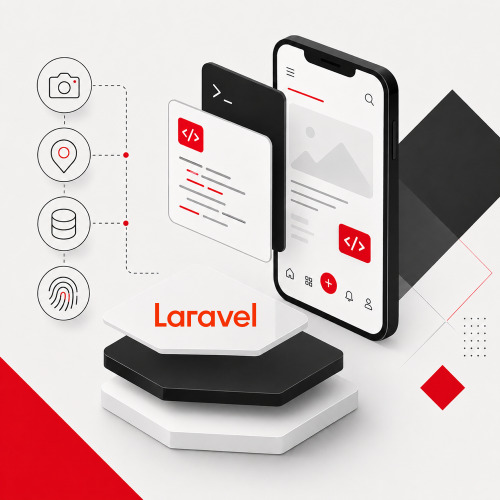
The technical foundation is based on several layers:
-
PHP runtime on the device: PHP is compiled with iOS toolchains and the Android NDK and runs natively on the operating system. No server roundtrip, no cloud dependency for core logic.
-
Laravel as application layer: The complete Laravel application (with Blade templates, Livewire components, Eloquent models, and routing) runs on the device. The SQLite database is deliberately stored outside the Laravel directory so that data persists during app updates.
-
Bridge mechanism (God Method): A bridge function connects PHP code with native Kotlin (Android) and Swift (iOS). Through a JSON-based protocol, PHP calls can be forwarded to the device's native APIs. Return communication occurs via an event system.
-
Plugin system: Instead of packing all device features into the core, NativePHP extracts functionalities into modular plugins. Camera, geolocation, file system, or biometric authentication are only installed when needed.
This modular approach solves a concrete problem: app stores are increasingly critical of apps that contain code for unused features. Through the plugin system, the core remains lean, compilation faster, and the review process smoother.
From WebView to "Super Native"
The most recent development is particularly noteworthy: under the working title "Super Native," a rendering approach is emerging that completely foregoes HTML, CSS, and WebView. Instead, UI components are directly translated into native elements, similar to how React Native converts JavaScript components into native views via the JavaScript Interface (JSI).
The crucial difference: since PHP is written in C, memory can be shared directly on the device side without needing to interpose an additional virtual machine. The result is genuine native controls with typical platform animations, such as ripple effects on Android or native transitions on iOS.
Initial benchmarks by the NativePHP team show impressive values: when processing 10,000 JSON elements, the approach is said to be around 83 percent faster than React Native and about 80 percent faster than Flutter. Individual PHP interactions are measured at around 6.88 milliseconds, which corresponds to a theoretical rate of about 146 frames per second. These figures refer to early development stages and should be interpreted with caution, but they show the potential of the approach.
What this means in practice
Unified tech stack from web to mobile
The most obvious advantage: one team, one stack, multiple platforms. Those already working with Laravel can use Livewire components and Blade templates to design native app interfaces. Existing packages from the Laravel ecosystem (such as Cashier for payment processing or Socialite for social login) can in principle also be used in the mobile app.
This not only reduces onboarding time but also reduces dependence on specialized mobile developers who remain difficult to find and costly in the job market.
Developer experience at a high level
The development experience is consistently oriented toward what Laravel developers know and appreciate:
- Three commands to a working app:
laravel new, NativePHP integration, andnative run, without needing to install Xcode or Android Studio. - Hot module reloading: Code changes are reflected in real-time on the device, even for native UI components. This drastically shortens the feedback loop.
- Familiar tools: Eloquent for the database, Blade for templates, Livewire for reactive components. Even
dd()(dump and die) works and displays debugging output directly on the smartphone.
Modular plugin ecosystem
The plugin architecture is not only technically sensible but also strategically smart. Each plugin defines its bridge functions, permissions, dependencies, and lifecycle hooks in a nativephp.json manifest file. The community can create their own plugins and offer them via a marketplace on nativephp.com, free or paid.
Already available plugins cover typical mobile functions:
| Functionality | Plugin | Cost |
|---|---|---|
| Camera / Video | mobile-camera |
Free |
| File system | mobile-file |
Free |
| QR code scanning | Integrated | Free |
| Microphone access | Audio plugin | Free |
| Augmented Reality | AR plugin | Variable |
| Biometrics | Biometrics plugin | Variable |
This model is reminiscent of proven ecosystems like Composer packages or npm modules and significantly lowers the barrier to entry for extensions.
Strategic classification: When does this approach make sense?
NativePHP is not a replacement for every type of mobile development. It is important to realistically assess its strengths and limitations.
Well suited for:
- Internal business apps and portals that build on existing Laravel infrastructure
- MVPs and prototypes where time-to-market is crucial
- Data-driven applications with forms, lists, dashboards, and CRUD operations
- Companion apps to existing web platforms that need a native presence in app stores
- Offline-capable applications, since Laravel works locally on the device with SQLite
Carefully consider for:
- High-performance graphics applications or games that require GPU-intensive calculations
- Apps with very complex native integrations that require deep operating system access
- Large teams that have already invested in Swift/Kotlin and whose workflows are established
The decision ultimately depends on where the team's core competency lies and what type of app is to be built. For PHP teams that have not been able to build mobile competency until now, NativePHP opens up a realistic path to app stores.
From idea to app: The typical workflow
The development process with NativePHP follows a structured but uncomplicated flow:
1. Set up project
A new Laravel project forms the basis. NativePHP is installed and configured as a Composer package. Configuration is limited to a few questions: app name, bundle ID, and target platforms.
2. Develop UI
The user interface is built with Blade templates and Livewire components. So-called "Edge" components are available for native elements: top bars, bottom navigation, side menus, and dialogs that are implemented as genuine Blade components and deliver native look and feel.
Those who use Tailwind CSS benefit additionally: NativePHP contains a Tailwind parser that maps utility classes to native styling properties.
3. Integrate native features
Through the plugin system, the required device functions are added specifically. The API is deliberately kept simple: a camera call is a one-liner, a geolocation request is a function call.
4. Test and deploy
Hot reloading enables fast iteration cycles directly on the device. For publication in app stores, Bifrost, a cloud-based build and deployment tool (comparable to Laravel Forge), is available, which centrally manages certificates, provisioning profiles, and app store submissions without requiring Xcode or Android Studio to be installed locally. With the accompanying companion app Jump, builds can also be deployed directly to physical test devices via QR code.
The significance of open source for sustainable development
With the release of NativePHP Air (version 3) as a fully free and MIT-licensed open-source project in February 2026, accessibility has fundamentally changed (see official blog post on nativephp.com as well as coverage by Laravel News). Previously, a paid license was required. Now the core is available free of charge, while the business model relies on premium plugins and the deployment tool Bifrost.
This approach is particularly relevant for us as an agency that strongly relies on open source software. An open core with commercial extensions creates the balance between community growth and economic sustainability. According to the developers, the framework recorded over 30,000 downloads within a few weeks of opening and already dozens of published apps in the stores.
Where the journey is heading
NativePHP is in a phase of rapid further development. The roadmap includes:
- Expansion of "Super Native" components for fully native UIs without WebView
- More Edge components for typical mobile UI patterns
- Performance optimizations in rendering and PHP execution
- Expansion of the plugin library through community and core team
- Broader device support: With version 3.1, the minimum requirement was lowered from Android 13 (API 33) to Android 8 (API 26), covering the vast majority of all active Android devices
The "Super Native" technology in particular deserves attention. If the early benchmarks are confirmed in practice, PHP as a language for native mobile interfaces could become a serious alternative to established cross-platform frameworks.
Conclusion: PHP goes mobile, and that's relevant
NativePHP marks a turning point for the PHP and Laravel ecosystem. It answers a question that has occupied many web developers and their clients for years: How can existing web know-how be used to build native mobile presence without rebuilding the entire tech stack?
The answer is still young and evolving. Not every app should be built with NativePHP today. But for teams and companies whose digital infrastructure is based on Laravel, a concrete, economically sensible path to app stores is opening up.
We at mindtwo are actively following this development and evaluating NativePHP for suitable project scenarios. If you are considering extending your existing Laravel platform with a native app, we would be happy to discuss whether and how this approach fits your project. You can find more about our offering as a NativePHP agency on our services page.
Further sources
- NativePHP – Official documentation and downloads: Introduction to the framework with tutorials, plugin marketplace, and API reference
- NativePHP for Mobile is Now Free – Official blog post: Background on the open-source decision and the new licensing model
- NativePHP v3.1: The Biggest Performance Leap Yet: Technical details on extended Android device support
- Laravel News: NativePHP for Mobile is Now Free: Classification of the release strategy from the Laravel environment
- Statista: Share of Mobile Internet Traffic Worldwide: Statistics on mobile web traffic
- Fortune Business Insights: Mobile Application Market: Market analysis and growth forecasts